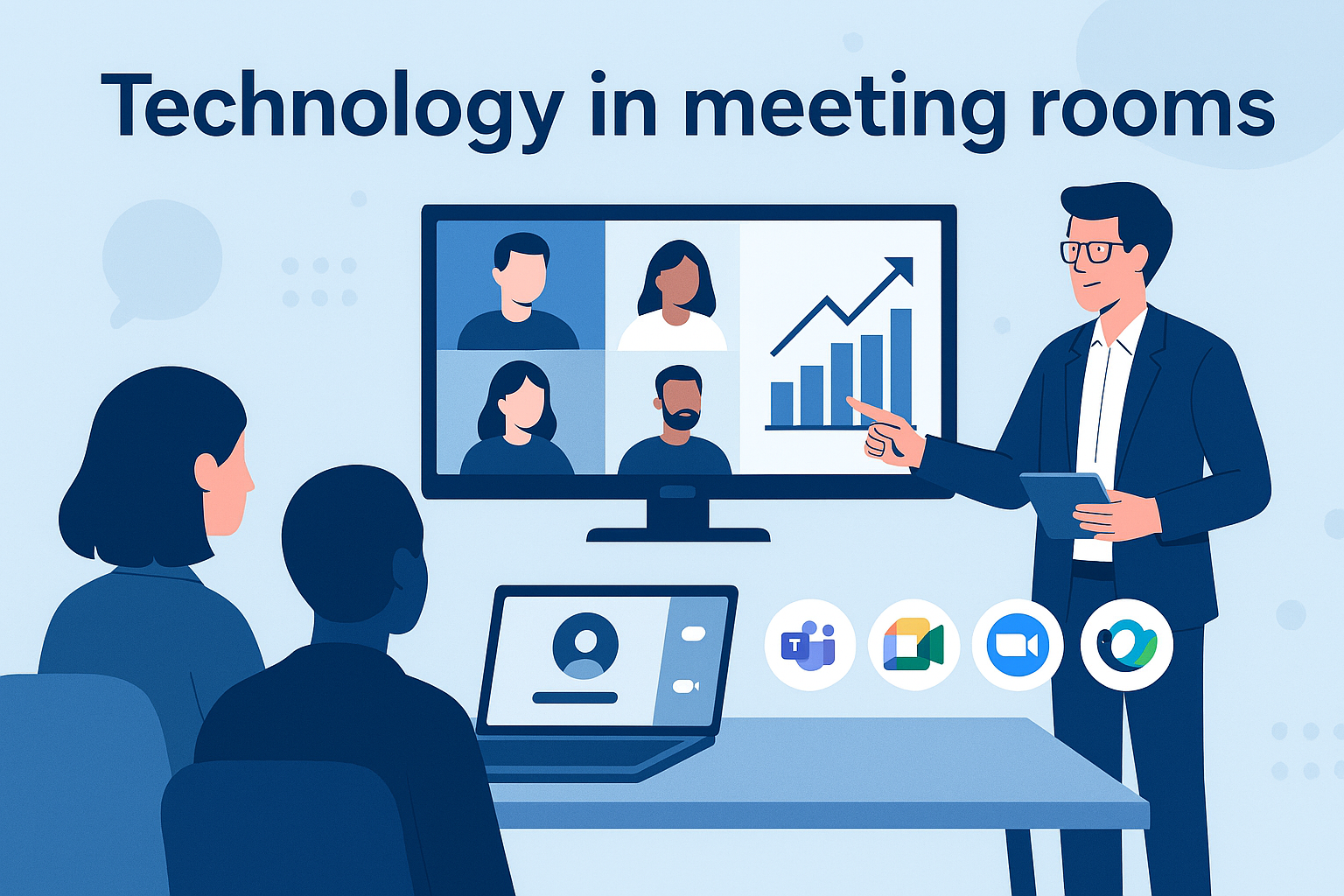
Discover how technology in meeting rooms supports presentations, video conferencing and hybrid collaboration using Teams, Zoom, Webex and Google Meet.
The modern workplace has changed forever, and nowhere is that transformation more visible than in today’s meeting rooms. Technology in meeting rooms is no longer a ‘nice to have’ — it is a critical enabler of productivity, collaboration and inclusion. Whether organisations are hosting quick presentations, global video calls, or fully immersive hybrid meetings, the right combination of platforms and hardware makes all the difference.
At meetingroom.technology, we explore how the right technology choices can transform under‑used spaces into powerful collaboration environments. Let’s look at how technology in meeting rooms supports different use cases.
Presentation Spaces: Simple, Reliable and Effective
For many organisations, the meeting room still begins as a presentation space. These rooms are designed for internal meetings, briefings, training sessions or client presentations, where content sharing is the priority.
Wireless presentation, high‑resolution displays, and intelligent cameras are now standard expectations. Vendors such as Maxhub, Yealink and Lenovo provide integrated display and compute solutions that keep these spaces simple to use and easy to manage.
Huddly cameras enhance presentation spaces with intelligent framing and lighting correction, ensuring a professional result even when meetings are recorded or shared.
Video Meeting Rooms: Connecting Teams Anywhere
As hybrid working has become the norm, video meeting rooms are a core requirement. These rooms are optimised for clear audio, sharp video and seamless integration with UC platforms.
Microsoft Teams, Zoom, Google Meet and Webex form the backbone of today’s video meeting environments. Certified hardware ensures meetings start on time and run without friction.
Audio quality is critical. Shure IntelliMix Room Systems provide advanced noise reduction, echo cancellation and audio processing directly within the room system, dramatically improving meeting clarity for remote participants.
Hybrid Collaboration Spaces: Designed for Equality
The most advanced meeting rooms today are hybrid collaboration spaces designed to create equality between in‑room and remote participants.
These rooms rely on intelligent cameras such as those from Huddly, flexible room layouts, and platform‑native experiences delivered through Microsoft Teams Rooms, Zoom Rooms or Webex Devices.
Vendors such as Yealink and Lenovo offer scalable room systems that can be deployed consistently across an organisation, from huddle spaces to boardrooms.
One Size Does Not Fit All
A successful meeting room strategy starts with understanding how each space will be used. A huddle room, training space and boardroom all require different technology approaches.
The most effective technology in meeting rooms is applied based on user needs, room design and organisational goals.
Why Expertise Still Matters
With so many platforms and devices available, navigating the world of meeting room technology can be challenging. Design, acoustics, user experience and platform choice all influence success.
If you are planning new meeting rooms or upgrading existing spaces, speaking to me, Rob, is the best call to action. I can help you design reliable, future‑ready meeting rooms that people enjoy using.
Technology in meeting rooms is about more than hardware — it’s about creating inclusive, effective spaces that bring people together.
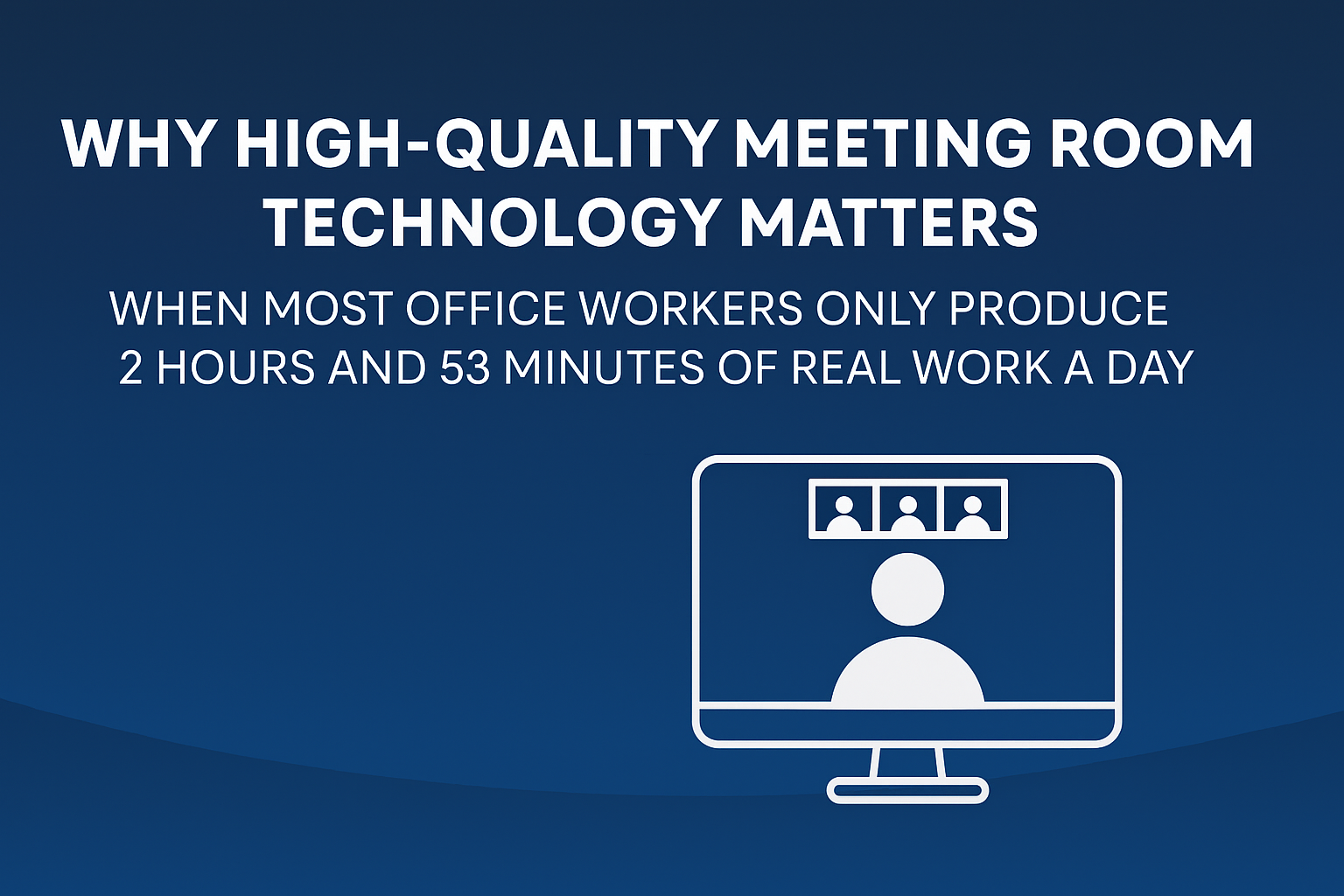
In modern office life, one surprising statistic keeps resurfacing: the average employee produces less than three hours of meaningful work per day. According to productivity research summarised by MyHours.com, workers are typically productive for just 2 hours and 53 minutes in an average 8‑hour office day.
It’s a remarkable figure — and one that should give every organisation pause. If the total amount of “real” productive time is already limited, the last thing any business can afford is avoidable disruption, especially the kind that comes from poor‑quality meeting room technology.
Because when you only have a narrow window of effective output each day, technology that wastes time is technology that costs money.
Distraction Is Already Eating the Workday
The same research highlights a long list of interruptions: task switching, digital distractions, chatty colleagues, and the now‑infamous endless meeting culture. All these factors build an environment where consistent focus is hard to achieve. And when workers lose focus, it can take 23 minutes to refocus after an interruption, according to related productivity findings.
Now imagine layering on top the delays caused by:
A display that won’t connect
Audio that cracks or cuts out
A camera that refuses to initialise
A Teams Room that needs rebooting again
A meeting that starts 10 minutes late because no one can share content
In a world where less than three hours of true productivity exist, those delays accumulate into a tangible operational cost.
Why Organisations Need Excellent, Reliable Meeting Room Technology
1. Because there’s no slack left in the system
With productivity already hovering under three hours per day, the margin for error collapsed long ago. When meeting room systems fail, they amplify a problem that already exists: too little productive time and too much time lost to friction.
2. Because modern collaboration relies on flawless connectivity
Hybrid work means every meeting is potentially a video meeting. Every discussion depends on screens, speakers, microphones, and connectivity that “just works.” When it doesn’t, teams lose momentum instantly — and momentum is incredibly expensive to regain.
3. Because businesses can’t afford new sources of unproductive time
The MyHours research shows the average worker spends large parts of the day dealing with time sinks. Companies increasingly recognise that productivity isn’t about squeezing in more hours — it’s about eliminating the obstacles that erode the few productive hours we actually have. [myhours.com]
A malfunctioning Teams Room, laggy conferencing setup, or unreliable BYOD connection isn’t a technical inconvenience — it’s a direct threat to productivity.
4. Because great meeting room technology reduces cognitive load
Workers already battle interruptions, context switching, and multitasking inefficiencies. Technology that’s intuitive and predictable reduces the mental overhead required just to communicate. The less people have to think about the tools, the more energy they can invest in the conversation.
The Business Case: Reliability = Recaptured Productivity
If your meeting rooms are frictionless — with:
Reliable room systems (Teams Rooms, Zoom Rooms, Hybrid setups)
Auto‑wake displays
High‑quality microphones and speakers
Consistent device behaviour
Easy content sharing
Minimal user steps
Then those precious 2 hours and 53 minutes will stretch further.
Conclusion: If Productivity Is Rare, Don’t Waste It
Whether the productivity figure is shocking, amusing, or slightly terrifying, it’s a wake‑up call. If the average worker only produces meaningful output for a small fraction of the day, then every minute matters.
And that’s why meeting room technology isn’t just an IT investment — it’s a productivity safeguard.
Reliable AV and UC systems don’t just help meetings run smoothly; they protect the limited amount of productive time that employees have to give. In a workplace where true focus is increasingly scarce, organisations simply cannot afford meeting rooms that steal even more of it.
Modern workplaces now rely on seamless meeting‑room technology in a way that would have been unthinkable a decade ago. Hybrid collaboration, intelligent meeting spaces and unified communications have transformed from “IT projects” into core strategic enablers of culture, productivity and employee engagement. With these rising expectations, one thing has become consistently clear:
Certification is no longer optional. It’s essential.
Certification proves expertise, reduces risk, and gives customers a visible signal that the people designing their meeting spaces genuinely know what they’re doing.
This article explores why certification matters so much in the world of modern meeting‑room technology, how Microsoft, Q‑SYS and Shure have elevated industry standards, and why hands‑on experience still remains the strongest differentiator of all.
Why Certification Matters in Modern AV/UC
As meeting‑room technology has evolved, so have the expectations placed on system designers, sales engineers and technical consultants. Today’s hybrid workplaces depend on solutions that are:
Stable
Predictable
Interoperable
Secure
Easy for end‑users to adopt
Certification is one of the few ways to reliably demonstrate that the people delivering these systems understand the standards behind them.
Certification gives buyers confidence
Clients can’t see your knowledge, but they can see your badges. Certifications publicly validate a consultant’s ability to design, deploy and support the technology they claim to specialise in.
Certification ensures technical consistency
Vendors create certification frameworks so partners deliver solutions that meet minimum—and often quite high—design and performance standards.
Certification supports employee experience
Today’s employees expect the office to offer a better meeting experience than joining from home. Certified solutions reduce friction and restore confidence in the physical workplace.
Microsoft: Raising the Bar for Meeting‑Room Standards
Microsoft has done more than almost any other vendor to formalise the pathway to AV and UC excellence. Their certification ecosystem provides recognisable, structured, meaningful credentials that directly map to real‑world expertise.
Certified for Microsoft Teams
Devices and room systems that earn the “Certified for Microsoft Teams” badge undergo rigorous testing to ensure they deliver high‑quality audio, video, security, device management and interoperability. When a consultant recommends certified hardware, it signals:
The solution will work reliably
It meets Microsoft’s performance standards
It will support consistent hybrid experiences
Microsoft Teams Rooms Sales & Technical Badges
Over the past two years, Microsoft has introduced role‑specific badges that demonstrate individual capability:
Teams Rooms Solution Sales Professional
Teams Rooms Technical Solutions Professional
These badges certify that you understand discovery, requirements analysis, room types, device ecosystems, licensing, architecture and support models. For presales consultants and technical designers, they instantly build credibility.
Microsoft Solutions Partner Designations
At an organisational level, the Solutions Partner for Modern Work designation has replaced legacy Silver/Gold competencies. It indicates that a partner consistently demonstrates:
Proven customer success
Strong technical capability
Reliable performance over time
These partner‑level badges give customers confidence that they’re working with a well‑rounded, competent provider—from initial design through to ongoing adoption.
Q‑SYS Certifications: Proof of System‑Level Understanding
Q‑SYS has become the backbone of many corporate AV deployments due to its software‑driven architecture, scalable platform and deep interoperability with modern UC ecosystems. Their certification pathway includes:
Q‑SYS Level Zero & Level One
These courses provide a foundational understanding of:
Q‑SYS Designer
DSP components
AEC
Audio routing
USB bridging
Conferencing design fundamentals
Level One culminates in creating a complete Q‑SYS conferencing design.
Q‑SYS Level Two
This hands‑on, classroom‑based certification demonstrates proficiency in advanced topics such as:
Networking and VLAN design
Custom UCI creation
Core‑to‑core streaming
GPIO and control integration
Advanced troubleshooting
Completing Level Two shows that you can design and commission complex, multi‑room or multi‑site AV deployments with confidence.
Shure Certifications: Mastery of Professional Audio in Hybrid Spaces
Shure remains synonymous with high‑quality audio, especially in modern conferencing environments. With products like MXA arrays, IntelliMix DSP and the full Microflex Ecosystem, they’ve developed training and certification pathways that elevate technical competencies across the board.
Shure Integrated Systems Certifications
These include training in:
Microflex Ecosystem architecture
IntelliMix processing
Networked audio
Wireless microphone deployment
Conferencing system commissioning
Advanced Integrated Systems Workshops
These workshops provide hands‑on, in‑person training on:
Deploying Shure systems end‑to‑end
Troubleshooting DSP, RF, and networking issues
Designing audio for challenging spaces
Understanding acoustic behaviour and tuning strategies
For meeting‑room technology, where audio is the biggest determinant of meeting success, certified Shure expertise is a major differentiator.
The Early Days: When Experience Was a Requirement, Not an Advantage
When I began working in video conferencing, certification wasn’t the focus—it was demonstrable technical skill. Vendors wouldn’t even consider you as a reseller unless you could show:
A working demo kit
Deep knowledge of codecs and standards
A solid grasp of bandwidth requirements and QoS
The ability to configure and troubleshoot live
In those days, you had to prove your competence before you were allowed near a customer.
Today, the industry is bigger, more accessible and more complex. The technology is more integrated, and the stakes are far higher. But the principle hasn’t changed:
The people designing and selling meeting‑room solutions must genuinely understand them.
Why All This Matters: Employee Experience & the Return to the Office
In hybrid workplaces, employees need a compelling reason to come into the office. And research consistently shows that people come in for:
Better collaboration
Better connection
Better meeting experiences
If the room technology fails, confidence collapses. Employees drift back to remote work. Leaders lose trust. Culture weakens.
Certified expertise—paired with real hands‑on experience—ensures that:
Rooms work first time, every time
Meetings feel fair and inclusive
Technology enhances, not hinders, collaboration
People actually want to use the spaces designed for them
In this way, certification isn’t just a technical standard; it’s a human one. It protects the employee experience and makes the workplace somewhere people feel confident returning to.
Certification + Experience = Trust
Certification demonstrates structured knowledge. Experience shows wisdom, intuition and calm under pressure.
When combined, they create the most powerful differentiator in today’s AV and UC market:
Trust.
Trust that the solution will work. Trust that issues will be solved. Trust that the office is worth the commute. Trust that the meeting will be productive.
For organisations investing in modern meeting‑room technology, nothing is more valuable.
Workplace design is undergoing one of the most significant shifts in decades. At this year’s Workplace Design Show, one theme stood above all others: people no longer accept generic workplaces. They want environments that earn the commute, support their best selves, and help them operate as part of a collective with shared purpose.
Organisations, meanwhile, face the challenge of balancing cost pressures, productivity expectations, hybrid complexity, and the ongoing need to build culture. Increasingly, technology — especially meeting room and workplace intelligence — has become the foundation that holds this new social contract together.
This page explores key themes shaping today’s workplace, and introduces solutions from Huddly, Neat, Maxhub — and now, Sony Nimway — that help create workplaces where teams genuinely thrive.
1. The New Workplace Social Contract: Community, Trust and Shared Purpose
The workplace is no longer defined purely by its physical layout — it is a social contract built on human connection.
People now come to the office for:
Serendipitous interactions
A shared sense of purpose
Mutual accountability
A community that lifts them beyond the individual self
Employees want environments tailored to how they work. Flexibility, personalisation, and meaningful interaction now define the value of the workplace.
Want to create workplaces people choose to come to? Email us today
2. Why People Still Come to the Office: Belonging, Networks and Access
People return to the office because it provides networks they cannot access at home — the hum of activity, chance encounters, quick problem‑solving moments, and access to shared tools.
But hybrid patterns fluctuate. Some days are vibrant; others are quiet. Meeting rooms and shared spaces must therefore support equitable collaboration regardless of who is physically present.
3. Designing for the Next 4–5 Years: Human‑Centred Hybrid Spaces
Hybrid work isn’t temporary — it is now a core operating model. Organisations must design spaces with the next 4–5 years in mind, ensuring they have:
High‑quality amenities
Psychological safety
Frictionless technology
Spaces that genuinely “earn” the commute
Meeting room technology is one of the most powerful enablers of this experience, allowing teams to collaborate without barriers or distractions.
4. The Hybrid Challenge: Expectations vs Reality
Hybrid introduces new operational pressures: inconsistent attendance patterns, demand for more meeting equity, and higher expectations for seamless digital collaboration.
Productivity today is measured by impact, not presence — and meeting room performance is central to that impact.
5. How Meeting Room Technology Supports the Modern Workplace
To build high‑performance collaboration spaces, organisations need solutions that offer:
Consistent and natural audio/video
Simple operation across all room types
Scalable, modular architectures
AI‑driven automation
Equity between in‑room and remote participants
Huddly — Multi‑Camera Intelligence
Huddly’s AI‑directed multi‑camera solutions, such as Huddly Crew, deliver natural, inclusive hybrid experiences by capturing non‑verbal cues and dynamically adjusting framing in real time.
Neat — Human‑Centred Collaboration Devices
Neat devices offer beautifully simple, purpose‑built hardware with intelligent framing, reliable audio, and effortless BYOD support — giving teams a frictionless meeting experience.
Maxhub — Scalable Teams Rooms Ecosystems
Maxhub provides all‑in‑one displays, Teams Rooms systems, and enterprise‑grade video bars that make it easy to standardise meeting technology across an entire workplace portfolio.
6. Sony Nimway — The Intelligence Layer Behind the Workplace
While Huddly, Neat and Maxhub elevate collaboration quality inside meetings, Sony Nimway elevates everything around them — giving organisations the data intelligence needed to design, plan, and continually improve their workplaces.
The Power of Nimway Analytics
Nimway is far more than a booking system or wayfinding tool. Its real value lies in its analytics and reporting platform, which gives organisations a precise, factual understanding of how their workplace is truly being used — not how people *think* it is being used.
Desk and room occupancy analytics
People‑flow and movement insights
Bookings vs actual usage
Identification of unused, overused, and mis‑sized spaces
Evidence‑based heatmaps showing spatial behaviour
These insights empower workplace, FM and real estate teams to make informed decisions that are backed by data — not guesswork.
Why Analytics Matter
Organisations often make costly decisions about refurbishment, expansion, downsizing, or redesign without ever truly knowing how their space is being used. Nimway solves this by giving leaders:
A single source of truth about occupancy
Evidence for business cases and investment decisions
Long‑term trends that highlight changing behaviours
Clarity on which rooms work, which don’t, and why
When you genuinely understand how your spaces perform, you can build a workplace strategy that is aligned with reality — and maximise the value of every square metre.
Nimway + Meeting Rooms
Nimway complements Huddly, Neat and Maxhub perfectly. While they improve the meeting experience, Nimway ensures the room itself is the right size, in the right place, and used in the right way.